
India has no plans to ration fuel supplies despite ongoing disruptions in global energy markets, according to a top oil ministry official. The country has maintained adequate inventories of crude products and LPG while diversifying imports to manage supply risks.

US Secretary of State Marco Rubio's visit to India this week underscores the complex dynamics of global energy policy, as Washington re-evaluates sanctions on Russian oil buyers amidst India's continued reliance on Russian crude.

The Sports Authority of India (SAI) and Indian Oil Corporation have signed an MoU for Rs 40 crore over two years to bolster boxing in India. This partnership, leveraging CSR funds and SAI's expertise, aims to enhance talent identification, athlete development, coaching, and international exposure for boxers, aligning with the revamped Khelo India Scheme.

An IndianOil officer, Mahesh Shelke, was fatally attacked with a sharp weapon while inspecting a petrol pump in Hingoli district, Maharashtra. Petroleum Minister Hardeep Singh Puri and Indian Oil Corporation have called for swift and strict action against those responsible. The incident draws parallels to the 2005 killing of another IOC officer, S Manjunath.

'India should not trade away its energy security for temporary tariff relief. Neither signing a trade agreement nor stopping Russian oil purchases can protect it from future US action.'

The Finance Ministry is set to commence its pre-budget meetings on October 12, initiating preparations for the Union Budget 2027-28, which will be the fourth budget of the Modi 3.0 government and the tenth for Finance Minister Nirmala Sitharaman.

China has strongly rejected a US bill that would impose tariffs on countries, including India, for purchasing Russian oil and gas. Beijing views the "Lindsey O Graham Sanctioning Russia and Iran Act 2026" as an act of "long-arm jurisdiction" and interference in its sovereign trade relations, asserting that its economic cooperation with other nations is based on equality and mutual benefit.

Petrol pump dealers seek exemption from the proposed 5 UPI charge on fuel purchases above 2,000, citing pressure on their margins.

A post by the oil ministry featuring V.D. Savarkar alongside Mahatma Gandhi and other freedom fighters has drawn criticism from the Congress party, accusing the BJP of distorting history.

India's core infrastructure industries recorded a significant growth of 7.9 per cent in September 2026, up from 3.1 per cent in the previous year, primarily fuelled by robust performances in iron ore, electricity, and cement production.

Nepal has condemned a drone attack on Saudi Arabia's Shaybah oilfield that resulted in the death of a Nepali migrant worker and injuries to others. The incident, which also killed a Filipino national and injured Indian and Pakistani nationals, occurred amid escalating tensions between Saudi Arabia and Yemen's Houthi rebels. Another attack on King Fahd International Airport also claimed an Indian life.

A Liberia-flagged oil tanker, Aframax Rio, carrying 23 Indian nationals, was attacked by drone boats off Russia's Black Sea coast near Sochi. All crew members were safely evacuated, though a significant fire is burning. The incident highlights escalating risks to commercial shipping in the Black Sea amid the Russia-Ukraine conflict, prompting India to express grave concern over attacks on international waterways.

An Indian national was killed and two others were injured in an attack on King Fahd International Airport in Dammam, Saudi Arabia. This incident follows another attack on the Shaybah oilfield where an Indian was also injured, amidst escalating strikes by Yemen's Houthi rebels on Saudi infrastructure.

The Indian government has revised its windfall tax on fuel exports, increasing the levy on petrol exports to Rs 2.5 per litre while cutting the duty on diesel exports to Rs 8.5 per litre, effective October 16.

US Secretary of State Marco Rubio kick-started a three-day visit to India on Tuesday to advance bilateral ties in energy, trade and investment, defence, critical technologies, and exchange views on the West Asia crisis.

India's wholesale price-based inflation surged to 11.39 per cent in September, up from 9.92 per cent in August, primarily driven by increasing prices of food, manufactured items, and fuel and power.

US Secretary of State Marco Rubio is on a three-day visit to India to discuss bilateral ties in energy, trade, investment, defence, and critical technologies, as well as the West Asia crisis. His visit aims to strengthen the India-US Comprehensive Global Strategic Partnership amidst existing friction, with a focus on finalising a proposed bilateral trade deal.

'If crude remains above $100 per barrel, with restricted retail-price increases, OMCs could face negative petrol and diesel marketing margins, higher LPG under-recoveries, higher crude-landing, freight and insurance costs, working capital and debt accumulation and inventory losses if crude subsequently corrects sharply.'

Five Indian nationals aboard a Kuwait-flagged tanker were safely shifted ashore after the vessel was struck by a projectile in the Strait of Hormuz, the Embassy of India in Oman said.

The Indo-Tibetan Border Police (ITBP) is undergoing a significant modernization drive, establishing drone platoons, developing a new 'Strike' course for Galwan-like situations, and constructing underground infrastructure along the Line of Actual Control. This strategic shift, announced by DG Shatrujeet Singh Kapoor, aims to counter China, identified as India's 'biggest adversary,' by embracing modern warfare techniques learned from recent global conflicts.

India has stated its commitment to protecting its economic interests and ensuring energy security after the US House of Representatives passed a bill allowing the US President to impose tariffs of up to 100 per cent on countries, including India and China, for purchasing Russian crude oil. The Ministry of External Affairs affirmed India's resolve to maintain diversified energy sourcing and has articulated its concerns to US interlocutors regarding the bill's potential implications.

Chinese President Xi Jinping is set to visit the United States from September 23 to 25 for summit talks with US President Donald Trump, with discussions expected to cover critical economic and trade issues, including AI, and the recently signed US sanctions law targeting countries buying Russian oil and gas.

India has condemned an attack on a Panama-flagged oil tanker off the coast of Oman, which resulted in one Indian seafarer going missing and 13 others being rescued. The Ministry of External Affairs is closely monitoring the situation and coordinating with Omani authorities for search and rescue operations, while also reiterating calls for de-escalation and safe navigation in the region.
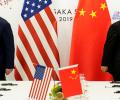
Top US and Chinese officials, including Vice Premier He Lifeng and Treasury Secretary Scott Bessent, held "candid, in-depth and constructive" talks in New York on economic and trade issues, with a specific focus on artificial intelligence. These discussions precede Chinese President Xi Jinping's anticipated visit to Washington and occur amidst new US sanctions targeting countries purchasing Russian oil and gas, and the US unveiling an "AI Force."

'If you listen to a rowdy in a class, he will keep on bullying you.' 'India can say do whatever you want. We will not compromise on anything.'

Amidst the ongoing conflict in West Asia, the Oil Ministry assures citizens that India's LPG supply remains secure, with no need for panic booking of cylinders. The normal delivery cycle of two-and-a-half days is being maintained, and crude oil is being sourced from diverse routes.

Prime Minister Narendra Modi and US President Donald Trump held a telephone conversation to review progress in bilateral ties, covering trade, defence, and energy, against the backdrop of heightened trade friction due to the 'Lindsey O. Graham Sanctioning Russia and Iran Act of 2026'.

India on Tuesday reiterated the call for free and safe navigation in international waters and the unhindered flow of commerce through international waterways in the region after the Panama-flagged commercial vessel MT El Gaia came under attack off the coast of Oman, with 13 of the 14 Indian nationals on board rescued while search operations are underway for one missing seafarer.

'It is a blunt and dangerous attempt to pressure India to sign BTA on one-sided terms.'

India's wholesale price-based inflation (WPI) increased to 9.92 per cent in August, up from 9.78 per cent in July, primarily due to rising prices across food, manufactured items, and fuel and power sectors.

India has expressed serious concern over Houthi attacks on Saudi Arabia's civilian infrastructure and economic assets, stating that such actions threaten regional stability and freedom of navigation through the Bab-el-Mandeb strait. External Affairs Minister S Jaishankar discussed the issue with his Saudi counterpart. India also condemned the targeting of commercial shipping after an Indian national went missing following an attack on a Panama-flagged ship off Oman.
India-US ties may be strained, but abandoning the relationship is not the answer; India must deal with Washington firmly without becoming either servile or hostile, asserts Ambassador T P Sreenivasan.

The Indian government has dismissed concerns that the use of E20 fuel could affect the validity of vehicle insurance policies, stating that the ethanol blending programme remains safe, consumer-friendly, and economically beneficial.
With state-owned oil marketing companies strapped for cash on account of selling products at subsidised rates, the Oil Ministry last week approached the Finance Ministry seeking oil bonds in advance for the second and third quarters of the current fiscal 2008-09.

The Petroleum Planning and Analysis Cell (PPAC) has denied an RTI request for data on oil imports from Russia, citing its 'commercial and confidential' nature and exemptions under the RTI Act. The Central Information Commission supported this decision, referencing strategic and economic interests.

US President Donald Trump is expected to sign the Lindsey O. Graham Sanctioning Russia and Iran Act of 2026 later on Friday (local time). A White House official confirmed the development to ANI without revealing further details.

The fiscal consolidation path and Rs 1 trillion stabilisation fund provide room to absorb mild shocks, but sustained oil-price increases pose risks.

Trade and business associations across India are organising a 'No UPI Day' on October 2 to protest the upcoming 0.4 per cent merchant discount rate (MDR) on Unified Payments Interface (UPI) transactions exceeding 2,000, effective from October 15.

India has once again raised alarms over the escalation in the security situation in the Red Sea area and strongly condemned Houthi strikes targeting Saudi Arabian territory, "including on civilians and economic assets."

India bought 1.87 million barrels of Russian oil per day in May so far, meeting approximately 40 per cent of its oil imports.
